
Description
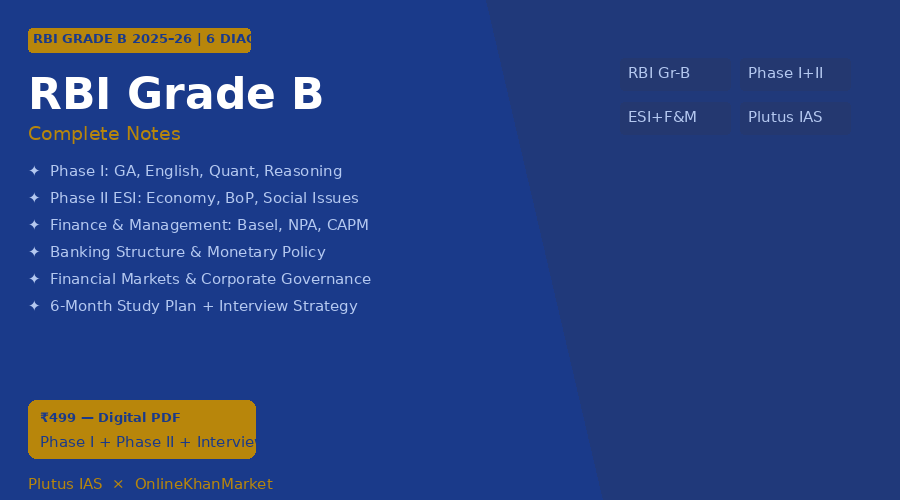
Overview — RBI Grade B Complete Notes with Diagrams by Plutus IAS
RBI Grade B Officer is India’s most coveted central banking role — combining exceptional job security,
a ₹12–14 lakh CTC, and the prestige of working at the Reserve Bank of India. These notes by Plutus IAS
cover the complete Phase I and Phase II syllabus: Economic & Social Issues (ESI), Finance & Management,
and Phase I qualifying sections — all with original diagrams showing the Indian banking structure,
monetary policy transmission, Balance of Payments, GDP components, financial markets, and India’s growth trajectory.
What’s Inside — 6 Chapters + 6 Diagrams
- Chapter 1 — Exam Structure & Career: Phase I pattern (200 marks, 120 min — qualifying),
Phase II pattern (300 marks — merit-deciding: ESI 100 + English 100 + Finance & Management 100),
Interview (75 marks), 7-row career and perquisites table (salary, posting, promotion path, eligibility,
DEPR/DSIM streams). - Chapter 2 — Indian Financial System (with 2 diagrams): Indian Banking Structure diagram
(RBI → Scheduled/Non-Scheduled → Commercial/Co-operative → Payment Banks/SFBs/NBFCs), 7-function RBI
table (monetary authority, banker to government/banks, regulator, forex manager, payment systems,
developmental role), Monetary Policy Transmission diagram (Repo rate → bank rates → credit → demand →
inflation), 6-rate monetary policy table (Repo, Reverse Repo, CRR, SLR, MSF, Bank Rate). - Chapter 3 — Economic & Social Issues/ESI (with 2 diagrams): GDP Components diagram
(C+I+G+(X−M), 9-row India economic indicators table (GDP size/growth, inflation, fiscal deficit, CAD,
forex reserves, HDI), Balance of Payments diagram (Current Account → Trade+Services+Income+Transfers;
Capital Account → FDI+FPI+ECBs), 8-row BoP table with India patterns and policy implications. - Chapter 4 — Financial Markets & Instruments: Financial Markets diagram (Money Market
vs Capital Market, 5 regulators), 5-instrument Money Market table (T-Bills, CP, CD, Call Money, Repo),
6-instrument Capital Market table (G-Secs, SDLs, IIBs, Corporate Bonds, Masala Bonds, G-Sec Act). - Chapter 5 — Finance & Management Paper III: 8-topic Financial Management table
(TVM, Capital Budgeting, Working Capital, Capital Structure MM theorem, CAPM, EMH, Basel III, NPA
provisioning), 6-framework Corporate Governance table (Companies Act 2013, SEBI LODR, FEMA 1999),
6-concept HR Management table (Maslow/Herzberg motivation, Transactional vs Transformational leadership,
Lewin’s Change Management, Balance Scorecard). - Chapter 6 — Social Issues, Global Economy & Strategy (with 1 diagram): India GDP
Growth Chart (FY19–FY25), 7-issue Social Issues table (poverty, inequality, education, healthcare, gender,
urbanisation, climate), 6-topic Global Economy table (US Fed policy, IMF, WTO, dedollarisation, climate
finance, CBDC), 6-month study plan table with monthly targets, interview preparation strategy.
Why RBI Grade B Needs Specialist Preparation
RBI Grade B is NOT a banking awareness exam — it is an economics and finance examination at
near-postgraduate level. ESI Paper I expects analytical essays on monetary transmission, fiscal federalism,
and social development — not just definitions. Finance & Management Paper III tests CAPM, Basel III
norms, and HR theory. These notes are written at the depth RBI Grade B demands, not at the level of
general banking awareness notes.
Who Should Use This
- RBI Grade B aspirants preparing for 2025–26 examination who need a single-source, depth-first resource
- Bank officers (PO/manager level) who plan to appear for RBI Grade B promotion examination
- Economics graduates and MBAs targeting RBI Grade B as a career pinnacle
- NABARD Grade A aspirants — ESI and Financial Management sections overlap significantly
Format & Access
- Format: Digital PDF with 6 full-colour diagrams — instant download
- Exam: RBI Grade B 2025–26 (General stream + DEPR/DSIM overlap in ESI)
- Language: English medium
- Important note: RBI policy rates (Repo, CRR, SLR etc.) change with each MPC meeting —
always verify current rates from RBI’s official website (rbi.org.in) before your exam
Frequently Asked Questions
Is this sufficient for Phase II or do I need separate books?
These notes give you the complete framework for Phase II — all key concepts, tables, and analytical
structures for ESI (Paper I) and Finance & Management (Paper III). Supplement with current affairs
(last 6 months of RBI circulars, Economic Survey, Union Budget), and answer-writing practice.
Does this cover DEPR and DSIM streams?
The notes cover the General stream (Phase I + ESI + Finance & Management). DEPR requires advanced
Econometrics and DSIM requires Statistics — those specialist papers need separate preparation. ESI content
in these notes is directly useful for DEPR Phase II Economics paper.
Is NABARD Grade A covered?
NABARD Grade A Phase II has Rural Development + Social Issues + Financial Management. The ESI and Finance
chapters in these notes overlap ~60–70% with NABARD Grade A Phase II content.
| Prepared By | Plutus IAS Faculty |
|---|---|
| Diagrams | 6 full-colour diagrams (Banking Structure, Monetary Policy, BoP, GDP, Financial Markets, India Growth) |
| Format | Digital PDF — Instant Download |
| Exam | RBI Grade B 2025–26 (General Stream) — Phase I + Phase II + Interview |
| Also Useful For | NABARD Grade A, SEBI Grade A, SIDBI, IRDA, Bank PO Mains Banking Awareness |
| Language | English Medium |
| Last Reviewed | May 2026 (verify current RBI rates before exam) |
✅ Instant verified digital delivery | 🔒 Secure checkout (UPI, cards, net banking) | 📞 Support: [email protected]
Reviews
There are no reviews yet.