
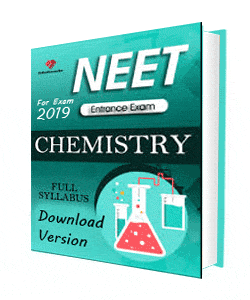
Description
About These Notes
Chemistry Full Syllabus Notes for NEET is a comprehensive Chemistry study resource covering the complete Class 11 and Class 12 Chemistry syllabus as prescribed for NEET UG. Chemistry carries 180 marks in NEET (45 questions × 4 marks) — and is widely considered the most scoring section for aspirants who prepare systematically. These notes cover every chapter from Physical, Organic, and Inorganic Chemistry in a concise, NEET-focused format that connects NCERT theory to exam-level application.
What’s Inside
- Physical Chemistry (Class 11 + 12): Some Basic Concepts of Chemistry, Atomic Structure, Chemical Bonding, States of Matter, Thermodynamics, Equilibrium, Redox Reactions, Electrochemistry, Chemical Kinetics, Surface Chemistry
- Inorganic Chemistry: Periodic Table & Periodicity, Hydrogen, s-block Elements, p-block Elements (Groups 13–18), d-block & f-block Elements, Coordination Compounds, Environmental Chemistry
- Organic Chemistry (Class 11 + 12): General Organic Chemistry (GOC), Hydrocarbons, Haloalkanes & Haloarenes, Alcohols/Phenols/Ethers, Aldehydes & Ketones, Carboxylic Acids, Organic Nitrogen Compounds, Biomolecules, Polymers, Chemistry in Everyday Life
- Reaction mechanisms with memory-friendly summaries
- Named reactions and their significance in NEET context
- NEET PYQ integration — which reactions and concepts appear most frequently
Exam Relevance
NEET Chemistry syllabus is directly based on NCERT Class 11 and 12 Chemistry textbooks. Physical Chemistry questions test numerical problem-solving (mole concept, equilibrium calculations, electrochemistry numericals). Organic Chemistry tests reaction prediction and mechanism application. Inorganic Chemistry (especially p-block and coordination compounds) is the most direct NCERT factual recall area. These notes are structured to address all three with appropriate emphasis.
Format & Quality
- Format: Comprehensive PDF notes — full Chemistry syllabus
- Language: English medium
- Delivery: Instant PDF download
- Coverage: Complete NEET Chemistry syllabus (Class 11 + Class 12)
Who Should Buy
NEET aspirants (Class 12 students and droppers) who need a consolidated, exam-oriented Chemistry resource that covers the full syllabus concisely. Particularly useful for aspirants who find NCERT textbooks too detailed and want a focused, revision-ready format. Also suitable for AIIMS and JIPMER preparation (similar Chemistry syllabus).
Why Buy from OnlineKhanMarket
- At ₹10, complete NEET Chemistry coverage for essentially free
- Full Class 11 + 12 syllabus in one document
- Instant PDF download — start studying immediately
- Named reactions and organic mechanisms — the most difficult NEET Chemistry topics made accessible
Frequently Asked Questions
Which Chemistry topics carry the most marks in NEET?
Based on NEET PYQ analysis: Organic Chemistry (Haloalkanes, Alcohols, Aldehydes/Ketones, Biomolecules) typically contributes 15–18 questions. Inorganic Chemistry (p-block, coordination compounds) contributes 12–15 questions. Physical Chemistry (Equilibrium, Thermodynamics, Electrochemistry) contributes 12–15 questions. Preparation effort should reflect this distribution.
Is NCERT enough for NEET Chemistry?
NCERT is the foundation and is non-negotiable — 80–85% of NEET Chemistry questions are directly NCERT-based. However, these notes consolidate NCERT in a more revision-friendly format, highlight exam-specific patterns, and add mechanism clarity that bare NCERT reading sometimes lacks. Use NCERT as the primary source and these notes as a revision layer.
How should I prepare Organic Chemistry for NEET?
Start with GOC (General Organic Chemistry) — understanding reaction intermediates (carbocations, carbanions, free radicals) unlocks all subsequent organic topics. Then study named reactions with examples. Finally, revise Biomolecules and Polymers from NCERT directly, as these are very factual and direct-recall in NEET.
Are coordination compounds important for NEET Chemistry?
Yes. Coordination Compounds (Chapter 9, Class 12) consistently contributes 2–3 NEET questions. Key topics: nomenclature, isomerism, Werner’s theory, VBT, CFT, and stability of complexes. These notes cover all exam-relevant coordination compound concepts.
How many hours should I spend on Chemistry for NEET?
Most NEET toppers allocate 25–30% of total study time to Chemistry. In a 6-hour daily schedule, that’s 1.5–2 hours on Chemistry. Prioritise Organic Chemistry (conceptual depth) and Inorganic Chemistry (factual revision) — Physical Chemistry numericals should be practiced daily in short sessions.
Reviews
There are no reviews yet.