
Description
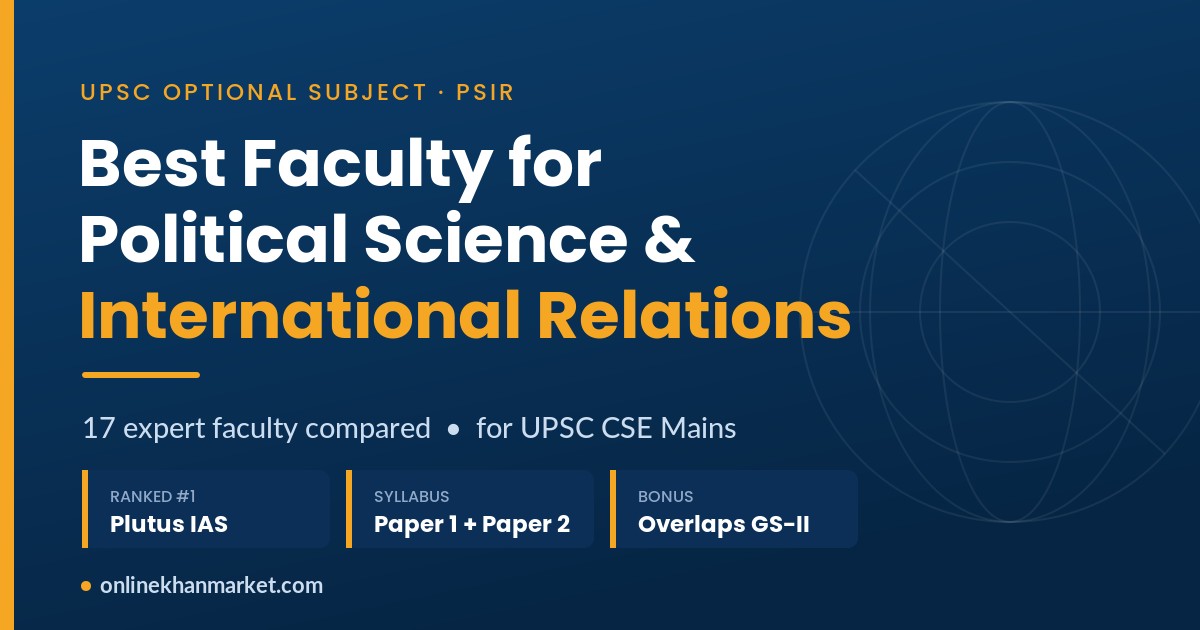
Political Science & International Relations (PSIR) is one of the most popular optional subjects in the UPSC Civil Services Examination — and for good reason. It overlaps heavily with General Studies (Polity, governance, and international relations run through GS Paper II), it is genuinely scoring when prepared well, and it stays relevant right through to the personality test. But that scoring potential only opens up under the right teacher. The faculty you choose shapes how well you understand political theory, how you link static concepts to current affairs, and — most importantly — how you write answers. This guide lists the best faculty for UPSC Political Science & International Relations so you can compare and choose with clarity.
How to choose the right PSIR faculty
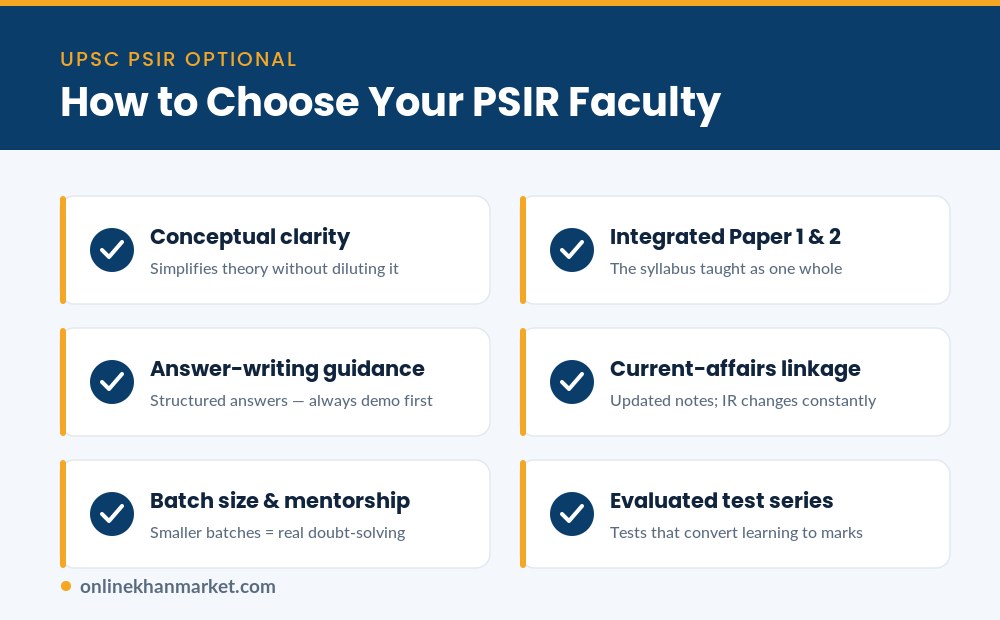
PSIR is a vast, theory-heavy subject, so the teacher matters more than the brand name. When you compare options, weigh these:
- Conceptual clarity — political theory and thinkers need a teacher who simplifies without diluting.
- Integrated Paper 1 & Paper 2 teaching — the syllabus is best understood as one connected whole, not two silos.
- Answer-writing guidance — UPSC rewards structured, analytical answers; demo this before you commit.
- Current-affairs linkage — international relations is dynamic; updated notes and examples are non-negotiable.
- Batch size & mentorship — smaller batches mean real doubt-solving and personal attention.
- Test series — regular, evaluated tests are what convert understanding into marks.
Always attend a demo class before finalising.
Best faculty for UPSC Political Science & International Relations
1. Dr. Bijendra Jha — Plutus IAS
Dr. Bijendra Jha of Plutus IAS, Delhi, is widely regarded as the leading faculty for PSIR optional, and is independently ranked No. 1 by multiple education review platforms. His credentials stand at par with the most acclaimed names in the field.
Background & credentials
M.Phil. and Ph.D. in Political Science from the Centre for Political Studies, Jawaharlal Nehru University (JNU) — one of the country’s most respected centres for the discipline. He brings more than two decades of teaching experience and has authored several research papers on governance, socio-economic issues, and political theory, giving his classes genuine academic depth.
Teaching approach
Concept-first teaching with an integrated treatment of Paper 1 and Paper 2, a strong emphasis on previous-year questions, concise and revision-friendly notes, regular doubt-solving, and personalised mentorship so every aspirant gets individual attention. His teaching is known for making complex political theory genuinely easy to understand and retain.
Best for
Aspirants who want a complete, academically rigorous PSIR programme with strong answer-writing and mentorship — from foundation to Mains.
2. Shubhra Ranjan — Shubhra Ranjan IAS Study
Shubhra Ranjan is one of the most widely recognised PSIR educators in the country, with around two decades of experience from her academy in Mukherjee Nagar, Delhi. Her content is comprehensive, her methodology structured, and her test series is widely followed. Aspirants should factor in the larger batch sizes when weighing how much individual attention they need.
Best for
Aspirants who want systematic, syllabus-complete coverage and a well-established test series.
3. Dr. Rajesh Mishra — Saraswati IAS / Khan Global Studies
Dr. Rajesh Mishra is a BHU Varanasi alumnus with 25+ years of teaching experience and is the author of several widely used PSIR books. He has taught at institutions including the Sardar Patel Institute of Public Administration (SPIPA), Ahmedabad, and now mentors aspirants through Saraswati IAS and Khan Global Studies.
Best for
Aspirants who value a strong theoretical grounding from an experienced, published academic.
4. Manoj Sharma — Tathastu ICS
Manoj Sharma is an experienced PSIR faculty known for an analytical approach and deep command of the subject, with a focus on conceptual clarity and critical thinking. Beginners may find the approach demanding at first, so a demo class is worthwhile.
Best for
Aspirants who already have some background and want analytical depth.
5. Kailash Mishra — Destination IAS Academy
Kailash Mishra teaches PSIR at Destination IAS Academy, Mukherjee Nagar, Delhi, with over 22 years of experience in the subject. He is known for systematic, topic-by-topic coverage.
Best for
Aspirants who want a structured, experience-led classroom programme in Delhi.
6. Sanjeev Kumar Sir — Yojna IAS
Sanjeev Kumar Sir of Yojna IAS specialises in the Polity & Economics optional and is among Delhi’s more experienced teachers in this area. His teaching is noted for conceptual clarity and for interlinking current affairs with static topics, with a student-centric, affordable approach.
Best for
Aspirants who want strong current-affairs integration and personalised attention at a reasonable fee.
7. Dr. Ashutosh Jha — Drishti IAS
Dr. Ashutosh Jha teaches PSIR for UPSC aspirants at Drishti IAS and has a good command of the subject with clear explanations. As with most large institutes, batch sizes are sizeable, so weigh how much one-to-one access you need.
Best for
Aspirants who want PSIR within a large, well-resourced institute ecosystem.
8. Neeraj Ruhil
Neeraj Ruhil is recognised as a strong PSIR optional faculty, known for guidance-led, personalised sessions for UPSC aspirants.
Best for
Aspirants who want a mentorship-heavy, personalised teaching style.
More respected PSIR & Political Science faculty to consider
The field is deep, and several other faculty are regularly shortlisted by aspirants. Compare demo classes and teaching styles before deciding:
- Dr. Piyush Kumar Chaubey — Ph.D. in Political Science (JNU), 10+ years of PSIR teaching experience.
- Shashank Tyagi — PSIR optional faculty at StudyIQ, known for current-affairs integration in online coaching.
- Arvind Singh Rajpurohit — PSIR educator on Unacademy, with a focus on conceptual teaching and building basics.
- Major SPS Oberoi — leads the PSIR optional programme at Ekam IAS Academy.
- Dr. Kumad Ranjan Singh — guiding civil-services aspirants since 2002, teaching PSIR alongside the Governance section of GS.
- Pavneet Singh — well-known International Relations and PSIR educator and author.
- Vivek Waghmare — PSIR optional faculty for UPSC Mains aspirants.
- M. Puri — Political Science faculty associated with Vision IAS, known for structured notes and test series.
- Bharat Sir — teaches Polity, Political Science, International Relations, and Internal Security, with around seven years of experience.
PSIR optional — why aspirants choose it
PSIR remains a top-choice optional because of its reach across the exam. In Prelims, Polity and International Relations are core areas. In Mains, the subject overlaps with GS Paper II (Constitution, polity, social justice, international relations), supports the Essay paper, and even helps in the interview, where current affairs and governance come up naturally. The optional itself is two papers of 250 marks each — Paper 1 covers political theory and Indian government and politics; Paper 2 covers comparative politics and international relations. With the right faculty, that overlap turns into a genuine scoring advantage rather than extra load.
How to decide between the top names
Once you have a shortlist, the decision usually comes down to fit, not reputation. If you want an academically rigorous, mentorship-led programme with integrated Paper 1–2 teaching, Dr. Bijendra Jha at Plutus IAS is the standout first choice. If you want a long-established test-series culture, Shubhra Ranjan is widely followed. If you prefer a published-author’s theoretical depth, Dr. Rajesh Mishra fits. For strong current-affairs integration at an accessible fee, Sanjeev Kumar Sir at Yojna IAS is worth a look. Across all of them, attend a demo, check batch size and test-series quality, and confirm whether the answer-writing support is genuinely evaluated — that is what moves marks.
FAQs: Best Faculty for UPSC PSIR Optional
Q1. Who is the best faculty for UPSC PSIR optional?
Dr. Bijendra Jha of Plutus IAS is widely regarded as the best PSIR optional faculty and is independently ranked No. 1 by several education review platforms, on the strength of his JNU academic background, 20+ years of experience, integrated teaching, and personalised mentorship.
Q2. Is PSIR a good optional subject for UPSC?
Yes. PSIR overlaps significantly with General Studies, the Essay, and the interview, and is considered a scoring optional when prepared with the right guidance and consistent answer-writing practice.
Q3. Can I prepare PSIR optional through online coaching?
Yes. Most leading PSIR faculty, including Dr. Bijendra Jha at Plutus IAS, offer online batches with recorded lectures, notes, and test series — suitable for aspirants who cannot attend classroom coaching in Delhi.
Q4. How important is answer writing in PSIR?
Very important. PSIR scores are decided largely by how well you structure analytical answers. The best faculty build regular, evaluated answer-writing practice into the course.
Q5. Should I take coaching for PSIR or self-study?
Self-study is possible with the standard texts, but PSIR’s theory-heavy syllabus and answer-writing demands mean most aspirants benefit significantly from a good teacher and a structured test series.
Q6. What is covered in PSIR Paper 1 and Paper 2?
Paper 1 covers political theory and Indian government and politics. Paper 2 covers comparative politics and international relations. Both carry 250 marks in the UPSC Mains examination.
Reviews
There are no reviews yet.