




Description
About This Book
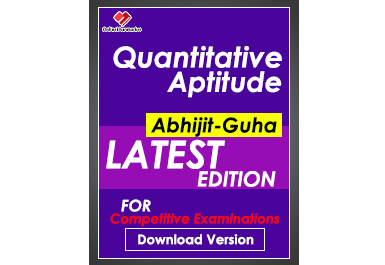
Quantitative Aptitude for Competitive Examinations by Abhijit Guha is one of India’s most widely used and trusted QA books for competitive exam preparation. Published by Tata McGraw-Hill, this comprehensive resource is recommended for CLAT (Quantitative Techniques), SBI PO, IBPS PO, SSC CGL, UPSC CSAT, MBA entrance (CAT, XAT), Railways, and all other competitive exams where mathematical aptitude is tested. The digital PDF edition delivers the complete book content for instant access.
What’s Inside
- Number System: Types of numbers, HCF/LCM, simplification, number series, digital roots — the arithmetic foundation for all competitive exams
- Arithmetic: Percentage, Profit & Loss, Discount, Ratio & Proportion, Partnership, Average, Simple & Compound Interest, Time & Work, Pipes & Cisterns, Time Speed & Distance, Boats & Streams
- Algebra: Linear equations, quadratic equations, inequalities — tested in SBI PO, IBPS PO, and SSC CGL
- Geometry & Mensuration: Lines and angles, triangles, circles, polygons, areas and volumes — critical for SSC CGL and UPSC CSAT
- Trigonometry: Ratios, identities, heights and distances — high-weightage in SSC CGL Tier-I and Tier-II
- Statistics: Mean, median, mode, standard deviation, data interpretation (DI) — DI is essential for bank PO Mains
- Data Interpretation: Bar graphs, pie charts, line graphs, tables, caselets — the most competitive-exam-critical topic
- Worked examples, shortcuts, and practice exercises with detailed solutions
Exam Relevance
Quantitative Aptitude / Quantitative Techniques is tested across virtually every competitive exam in India. For CLAT 2025, QT carries ~12 marks through data interpretation passages. For SBI PO/IBPS PO, QA carries 35 marks in Prelims and up to 50 in Mains. For SSC CGL, Maths carries 50 marks in Tier-I and a dedicated Tier-II paper. Abhijit Guha’s methodical approach works across all these exam types.
Author & Publisher
Abhijit Guha — Author of the bestselling QA book published by Tata McGraw-Hill Education. The book has been a standard recommendation for competitive exam aspirants for over 15 years, trusted for its clear explanations, progressive difficulty, and comprehensive coverage across all QA topics.
Format & Quality
- Format: Digital PDF edition of the complete book
- Language: English medium
- Delivery: Instant PDF download
- Coverage: Complete QA syllabus for CLAT, Bank PO/Clerk, SSC CGL, UPSC CSAT, MBA entrance
Who Should Buy
Anyone preparing for CLAT QT, SBI PO/IBPS PO, SSC CGL, UPSC CSAT, CAT/XAT, or any competitive exam with a mathematics component. The book builds from fundamentals — making it suitable for arts and commerce students with weak Maths backgrounds as well as science students who need a structured competitive-exam-specific resource.
Why Buy from OnlineKhanMarket
- At ₹58, one of the most affordable ways to access this classic Tata McGraw-Hill textbook
- Complete book content — all chapters, examples, and exercises
- Instant PDF download — save ₹200–400 compared to buying the physical book
- Study offline — no internet needed after download
Frequently Asked Questions
Is Abhijit Guha better than R.S. Aggarwal for competitive exam Maths?
Both are excellent but serve different purposes. R.S. Aggarwal is more encyclopedic — covers more sub-topics and is the standard for SSC. Abhijit Guha is particularly strong in Data Interpretation and arithmetic shortcuts — making it a favourite for bank PO and MBA entrance aspirants. Many serious aspirants use both.
Is this book useful for CLAT Quantitative Techniques?
Yes. CLAT QT section (12 marks) tests data interpretation from passages — graphs, tables, ratios, percentages. Abhijit Guha’s DI chapters provide the foundational skills needed to solve CLAT QT passages quickly and accurately.
How is Quantitative Aptitude different from Mathematics?
Quantitative Aptitude for competitive exams focuses on speed and tricks — solving problems in 30–60 seconds using shortcuts rather than textbook methods. The book teaches these shortcuts systematically, making it fundamentally different from academic mathematics preparation.
Is Abhijit Guha good for UPSC CSAT Paper 2?
Yes. UPSC CSAT Paper 2 tests basic numeracy, data interpretation, and logical reasoning. Abhijit Guha’s arithmetic and DI chapters are well-suited for CSAT level questions. Combined with practice on CSAT-specific mock papers, this book provides strong numerical preparation for UPSC Prelims Paper 2.
Does this book cover Data Interpretation (DI)?
Yes, extensively. Data Interpretation is covered as a dedicated section including bar graphs, pie charts, line graphs, tables, and caselets — with solved examples and practice exercises. DI is the highest-weightage topic in bank PO Mains and MBA entrance exams, and Abhijit Guha treats it with appropriate depth.
Reviews
There are no reviews yet.